
Anatomy of a sailing boat: hull, mast and sails
3 min read
Before any manoeuvre, you need to know what things are called. On a sailing boat almost every part has a precise name, and the skipper’s orders use them all. The good news: once you understand the logic, it all fits together.
The hull
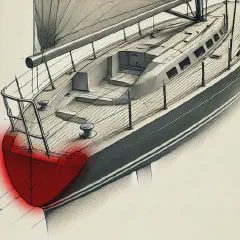
Let’s start with directions. The front of the boat is the bow and the back is the stern. Facing the bow, port is on your left and starboard on your right.
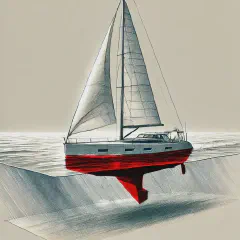
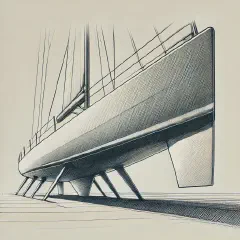
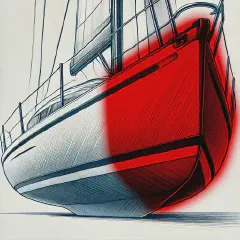
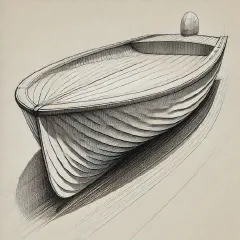
The body of the boat is the hull. The line up to which it sits in the water is the waterline: below it is the underwater hull, above it the topsides. The depth down to the lowest point of the hull is the draft – very important when entering a harbour or sailing in shallow water.
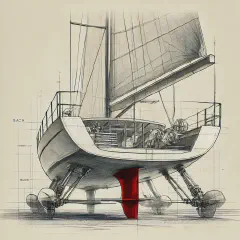
Under the hull, modern yachts have a ballasted keel that gives stability and stops the boat being pushed sideways by the wind. At the stern, the rudder changes the boat’s direction and is controlled from the helm.
Mast and rigging
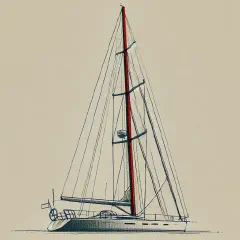
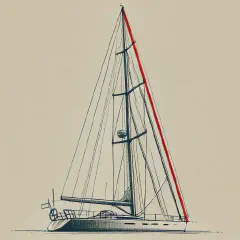
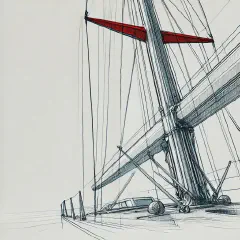
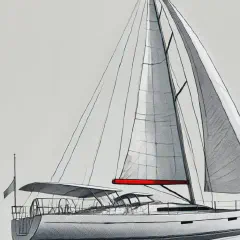
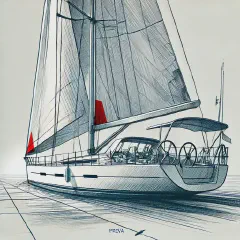
The mast is the vertical spar that carries the sails. To stay upright under the force of the wind it is held by wires: the forestay forward, the backstay aft and the shrouds at the sides, held away from the mast by the spreaders. Together these form the standing rigging.
Attached to the mast near the deck is the horizontal spar called the boom, along which the bottom of the mainsail is set. Watch out for it: in an uncontrolled gybe, the boom swings across violently.
The sails
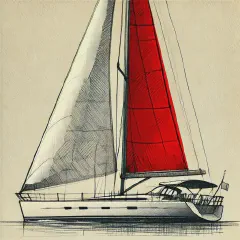
A classic cruising yacht has two main sails:
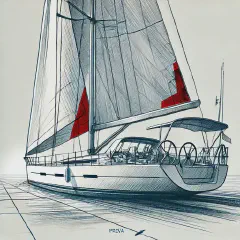
- the mainsail, set on the mast and the boom;
- the headsail, set on the forestay: a jib if it is smaller, or a genoa if it is large and overlaps the mainsail.
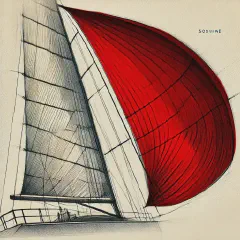
For downwind sailing, large light sails are used: the spinnaker and the gennaker.
Three edges and three corners
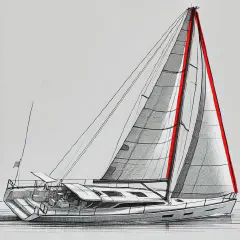
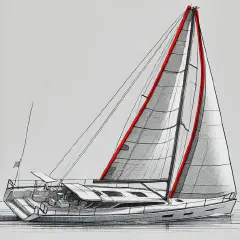
Every triangular sail has three edges and three corners, and their names come up in orders all the time:
| Part | English | Romanian |
|---|---|---|
| Front edge | Luff | Margine de învergare |
| Back edge | Leech | Margine de cădere |
| Bottom edge | Foot | Margine de întindere |
| Bottom front corner | Tack | Colț de mură |
| Bottom back corner | Clew | Colț de scotă |
| Top corner | Head | Vârful velei |
Memory tip: the sheet is attached to the clew – in Romanian it’s literally the “sheet corner” (colț de scotă). And the luff is the edge that’s attached along the mast or stay.
To help the sail keep its shape, thin battens are slipped into pockets, and for fine trimming you use telltales, ribbons that show how the air flows over the sail.
Terms in this guide

Read next

First steps on board: 20 terms to know from day one
Essential nautical terms for your first sail: directions on board, parts of the boat, deck equipment and the orders you'll hear from the skipper – with their Romanian equivalents.
Read
IALA buoyage explained: how to read buoys at sea
IALA Region A buoyage guide: lateral, cardinal, isolated danger, safe water and special marks – colours, shapes, topmarks and lights.
Read
Navigation lights in brief: what you show at night and what you see on the water
COLREG navigation lights explained simply: sidelights, sternlight, masthead and towing lights, their arcs of visibility and the combinations for sailing and power vessels.
ReadNAUTI
Romanian–English nautical dictionary and boating licence practice
Illustrated nautical terms with definitions and pronunciation in Romanian and English, plus mock exams, lessons and drills for the Romanian boating licence. No account, no ads, offline.