Navigation lights in brief: what you show at night and what you see on the water
3 min read
Between sunset and sunrise, and in restricted visibility, vessels are no longer recognised by their shape but by their lights. The COLREGs set out exactly which lights each vessel must show, and their combination tells you what kind of vessel you’re looking at, where it’s heading and what it’s doing.
Teaching summary. The full rules (including ranges of visibility, exact positions and special cases) are in the official COLREG text, Part C and the annexes.
The basic lights and their arcs
Each light is visible only over a certain arc, measured in degrees:
| Light | Colour | Arc | Visible from |
|---|---|---|---|
| Masthead | white | 225° | right ahead to 22.5° abaft the beam, on both sides |
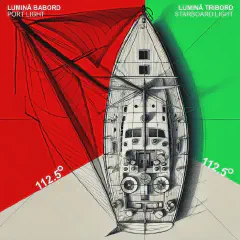
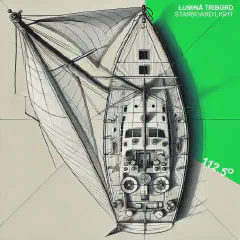
| Starboard sidelight | green | 112.5° | right ahead to 22.5° abaft the beam, to starboard |
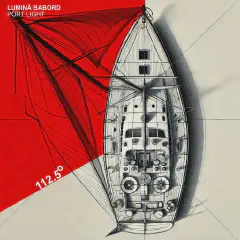
| Port sidelight | red | 112.5° | right ahead to 22.5° abaft the beam, to port |
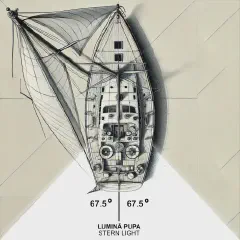
| Sternlight | white | 135° | astern, 67.5° each side |
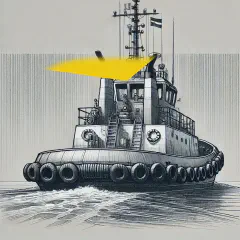
| Towing light | yellow | 135° | like the sternlight, placed above it |
| All-round light | varies | 360° | from every direction |
Notice how the arcs of the sidelights and sternlight fit together perfectly: 112.5° + 112.5° + 135° = 360°. From whatever direction you look at a vessel, you see at least one of them.
Memory tip: port wine is red – and the red light is on the port (left) side. And, like a traffic light: if you see another vessel’s red, you may be the one who has to give way.
What a sailing vessel shows
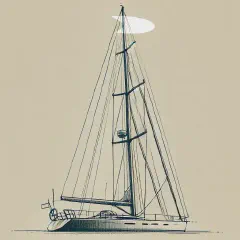
- Under sail: the sidelights (red and green) and the sternlight. It does not show a masthead light.
- Under 20 m: may combine the three lights in a single tricolour lantern at the masthead.
- Under 7 m: if it cannot fit the lights, it must have a white torch ready to show in time to prevent a collision.
- Motorsailing: for the rules it is a power-driven vessel and shows the corresponding lights (including the masthead light). By day, it shows a cone, point down.
What a power-driven vessel shows
A power-driven vessel underway shows the masthead light, the sidelights and the sternlight. Vessels over 50 m show two masthead lights, the aft one higher than the forward one – their alignment tells you which way the ship is heading.
Reading what you see
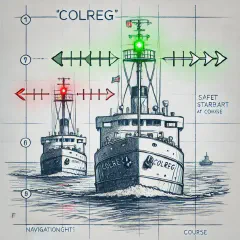
- You see red and green at the same time (perhaps with white above): the vessel is heading straight for you.
- Only green: the vessel is showing you its starboard side; it’s crossing from your left to your right.
- Only red: the vessel is showing you its port side; it’s crossing from your right to your left.
- Only a low white light: you’re astern of a vessel.
- Yellow above white: a towing vessel – beware of the tow line between it and the vessel being towed.
At anchor
A vessel at anchor shows an all-round white light where it can best be seen (large vessels show two). By day, it shows a black ball forward.
Terms in this guide
Read next

First steps on board: 20 terms to know from day one
Essential nautical terms for your first sail: directions on board, parts of the boat, deck equipment and the orders you'll hear from the skipper – with their Romanian equivalents.
Read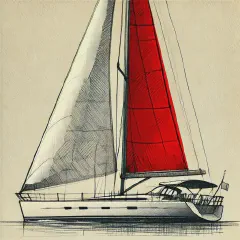
Anatomy of a sailing boat: hull, mast and sails
The parts of a sailing boat explained simply: bow, stern, hull, keel, mast, stays, mainsail, jib, and the three edges and three corners of a sail – with their Romanian names.
Read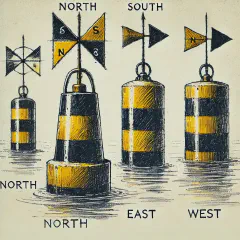
IALA buoyage explained: how to read buoys at sea
IALA Region A buoyage guide: lateral, cardinal, isolated danger, safe water and special marks – colours, shapes, topmarks and lights.
ReadNAUTI
Romanian–English nautical dictionary and boating licence practice
Illustrated nautical terms with definitions and pronunciation in Romanian and English, plus mock exams, lessons and drills for the Romanian boating licence. No account, no ads, offline.